
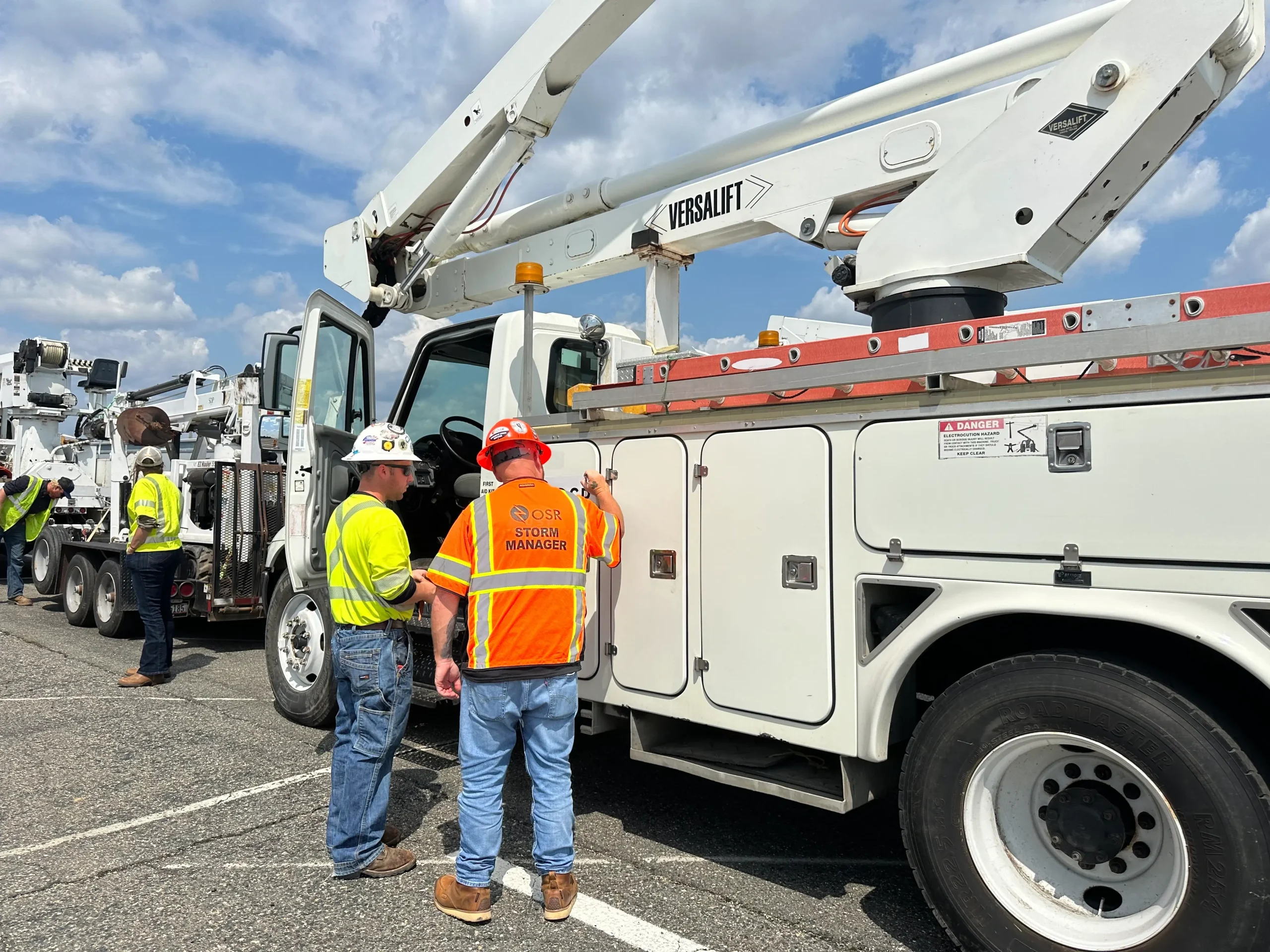
A bucket truck without tooling isn’t ready to work. A line crew arriving on-site with a bare rental unit and no compatible tools loses the first two to four hours of the day assembling what should have been there at dispatch — sourcing rubber goods from the nearest distributor, rigging hand tools from crew trucks, organizing body storage from scratch, and confirming grounding equipment is present before the first conductor is touched. Those hours are expensive: a line crew in the field costs $2,500–$4,000 per day in labor, per diem, and support costs. Losing 30% of day one to setup overhead isn’t a minor inconvenience — it’s real money on every short-duration rental. Tooled bucket truck rentals — units that arrive equipped with the rubber goods, grounding equipment, hand tools, PPE storage, and body configuration that a utility crew actually needs — are a different product than bare-truck rentals. The difference shows up in first-day productivity, storm restoration timelines, and total operational cost across the rental period. ATK Logistics provides tooled bucket truck rentals for utility contractors across the Southeast with properly configured units that crews can put to work from the moment they arrive on site.
—
What “Tooled” Actually Means in Utility Line Work
When utility contractors and utilities ask for a tooled bucket truck, they’re asking for a unit configured to support real line work — not a stock rental unit with a bucket attached. The tooling package reflects decades of collective knowledge about what a crew needs to execute utility work safely and efficiently. Here’s what separates a properly tooled unit from a bare rental:
Rubber goods and insulated equipment storage. Rubber gloves, rubber sleeves, and insulated cover-up are the personal protective equipment that allow linemen to work in proximity to energized conductors. They have to be stored correctly — in designated rubber goods holders, away from contaminants, protected from UV exposure and cuts. A properly configured utility bucket truck has rubber glove holders integrated into the bucket or boom, rubber goods storage on the truck body that keeps equipment accessible and protected, and hot-stick holders (for fiberglass live-line tools) in organized positions. A crew that has to improvise rubber goods storage is setting up conditions for damaged equipment and safety exposure. Rubber goods should be stored, inspected, and ready for use at the start of every shift — not organized from scratch at the job site.
Grounding equipment for energized and de-energized work. Ground sets — copper cables with clamps rated for the system voltage — are required for safe de-energized work. Ground rods for establishing temporary earth ground, bonding cables, and ground set storage are standard requirements for distribution line work. A tooled rental unit carries appropriately rated ground sets, ground rods, and bonding equipment that the crew can access and deploy without sourcing separately. The cost of a crew discovering that grounding equipment wasn’t included is always higher than the cost of confirming tooling before dispatch.
Conductor handling tools and rigging equipment. Distribution line work requires hand tools specifically engineered for working with conductors: wire holders (conductor saddles) that support phase and neutral conductors during maintenance work, conductor rollers for guiding wire through framing hardware during stringing operations, come-alongs (wire tensioning grips) for pulling conductors under tension, conductor-forming tools for split-bolt connections, and the specialized grips and fixtures used for different conductor types (ACSR, all-aluminum, covered conductor, URD cable). This equipment is specific to line work. It doesn’t come from a general hardware store. A bare rental truck doesn’t include it; a tooled unit does.
Body storage and organized compartments. A utility service truck body is more than a place to put things — it’s a working platform for job organization. Properly configured body storage includes lockable side compartments for materials and hardware, an interior job box for small parts and specialty tools, utility body rails for attaching equipment mounts (chain hoists, cable pullers, reels), and a designated safety equipment section for traffic cones, vests, caution tape, and first aid. When a truck body is organized from the factory around the work it does, a crew can find every tool in 30 seconds. When it’s improvised on a bare rental, setup takes the better part of a morning.
Traffic control and work zone safety equipment. OSHA and MUTCD standards require specific work zone setup for utility line work on or near roadways. Traffic cones, advance warning signs, flashing warning lights, and safety vests are required standard equipment. A tooled rental unit carries this equipment in designated storage rather than requiring the crew to source it separately.
Boom and bucket accessories. Tool boards in the bucket (magnetic or clipped holders for hand tools used at height), bucket-mounted rubber cover-up for energized work, and boom accessories like spotlight mounts for night work and equipment hooks for raising materials are features of utility-configured bucket trucks. These accessories are added at configuration and aren’t part of a stock aerial work platform rental.
—
Why Tooled Rentals Cost Less Than They Appear To
The sticker price comparison between a bare truck and a tooled truck favors the bare unit. The operational cost comparison inverts that conclusion almost every time. Here’s the math:
A typical bare bucket truck rents for $250–$350/day in the Southeast market. A tooled unit might be $310–$420/day — roughly a 20% premium. On a 10-day rental, that premium is $600–$700.
Now calculate the hidden cost of the bare unit:
– First-day crew time spent sourcing rubber goods from a distributor (2 hours, 3-person crew): approximately $240 in labor cost
– First-day setup and organization (1 hour): approximately $120 in labor cost
– Transportation time for tool procurement: approximately $60 in fuel and time
– Risk of unavailable or delayed specialized tooling (conductor grips, come-alongs): variable, often $500+ in delay cost on a compressed project
Total first-day overhead on a typical bare rental: $400–$600. On a 10-day rental, that first-day overhead closes the gap almost entirely. On shorter rentals (3–5 days), first-day overhead represents 20–33% of the total project time.
The efficiency advantage of tooled rentals compounds for storm restoration scenarios, where deployment windows are measured in hours and first-day productivity determines how quickly customers get power back. In a storm deployment, setup overhead isn’t just a cost — it’s delay measured in customer outage duration and utility performance metrics (CAIDI, SAIDI). A pre-arranged tooled rental that mobilizes and starts work in the first hour is worth substantially more than a cheaper bare rental that takes three hours to set up.
—
How Tooled Bucket Truck Rental Works: Step-by-Step
Understanding the end-to-end process helps contractors set expectations and prepare for efficient activation:
1. Define the work scope, voltage environment, and specific tooling requirements. Before requesting a quote, clarify the work environment: Is this energized work adjacent to primary voltage (Category A or B work zone)? What tooling is standard for this work type — rubber gloving, hot-stick work, de-energized maintenance? What conductor types are involved? What’s the project duration? Specific scope determines whether the standard tooling package matches your requirements or whether custom additions are needed.
2. Request a detailed tooling specification alongside the equipment quote. Ask the rental provider to list every item in the tooling package — rubber goods holders, ground set rating, hand tool list, body configuration, safety equipment. Don’t accept “tooled” as an undescribed category. Get the specifics. A tooling package verified before dispatch prevents discovering gaps after the crew is on-site.
3. Verify rubber goods currency and PPE condition. Ask when rubber goods were last tested. Rubber gloves and sleeves must be re-tested at 6-month intervals per ASTM D120 standards; outdated rubber goods are unsafe and non-compliant. Request documentation of test dates. If rubber goods are beyond test date, request replacement or testing before deployment.
4. Confirm grounding equipment is rated for system voltage. Ground sets are rated by voltage class. A ground set rated for 15kV is not appropriate for 35kV work. Confirm grounding equipment voltage rating against the system where the truck will operate.
5. Coordinate delivery logistics with tooling verification walk-through. When the unit arrives, conduct a joint walk-through with the rental provider confirming every item in the tooling package is present and in working condition. Document the checklist. A five-minute confirmation at arrival prevents mid-job scrambling.
6. Brief crew on tooling locations and truck body organization. Even experienced linemen benefit from a brief orientation on where specific tools are stored in an unfamiliar unit. Five minutes of “here’s where the ground sets are, here are the conductor saddles, here’s the PPE storage” saves time on every subsequent task.
7. Report missing or damaged tooling to the rental provider immediately. If tooling is discovered missing or damaged during the rental period, report it to the rental provider immediately. Rental providers who stand behind their tooling packages will address gaps quickly.
8. Return the unit with tooling intact and documented. At the end of the rental period, return the unit with tooling in original condition. Document return condition with the rental provider. Clear expectations about return condition prevent disputes.
—
Storm Restoration and the Case for Pre-Arranged Tooled Rentals
Storm restoration changes the calculus on rental setup time. After a major hurricane or severe storm event across the Gulf Coast or Southeast, utility contractors are managing multiple simultaneous deployment pressures: damage assessment, crew mobilization, equipment positioning, basecamp setup, and production line work — all compressed into the first 24–72 hours.
In that environment, a crew that can arrive at their assigned damage area, access properly equipped tools from the rental unit, and begin productive work immediately is worth more per shift than a crew spending the first hours organizing equipment. The productivity premium on properly tooled rentals is highest exactly when storm restoration demands are highest.
Pre-arranged tooled rental agreements — established before storm season (March–May) with confirmed tooling packages — provide contractors with:
– Guaranteed access during peak demand periods when equipment availability is constrained
– Pre-negotiated tooling specifications so there’s no ambiguity about what arrives
– Rapid activation protocols (typically 4–24 hours from event to on-site)
– Priority service from a provider who knows your operation before the emergency
Contractors who establish pre-season tooled rental agreements before hurricane season are positioned to mobilize faster and more productively than those making cold calls after the event. Equipment availability during active storm events is constrained. Pre-season agreements provide the capacity reservation that makes activation possible.
—
Tooled Rental Standards: Rubber Goods, Ground Sets, and OSHA Compliance
Line work with energized infrastructure has specific OSHA and ASTM standards governing the protective equipment used. A rental provider claiming to offer tooled units should be able to confirm compliance with these standards:
Rubber goods (gloves and sleeves) testing. ASTM D120 governs rubber insulating gloves for electrical work. Gloves must be re-tested at 6-month intervals. Each glove has a test date stamped on the cuff; gloves beyond test date are non-compliant and cannot be used for live-line work. ASTM D1051 governs rubber insulating sleeves. A rental provider maintaining tooled units should confirm that rubber goods are current on testing. Request the test date of rubber goods in the tooling package.
Ground set ratings. Ground sets are rated by maximum fault current and system voltage. Saxton and Anderson-brand ground sets are common; ratings are printed on the clamps and cables. A 15kV ground set (rated for 15kV systems) cannot be used on 35kV systems. Confirm ground set voltage rating matches system voltage where the truck will operate. OSHA 1910.137 and IEEE 1048 govern grounding equipment use.
Insulated hand tools. For work on or near energized circuits, insulated hand tools (screwdrivers, pliers, wire cutters) must be rated to 1,000 volts minimum per IEC 60900 and ASTM F1505. Non-insulated tools are not appropriate for any work in an energized environment. A properly tooled utility bucket truck carries IEC/ASTM-rated insulated hand tools.
Traffic control equipment. Work zone setup requirements under MUTCD (Manual on Uniform Traffic Control Devices) specify minimum equipment for road and right-of-way work. Standard requirements include advanced warning signs, cones (minimum 18-inch height), retroreflective vests, and flashing warning lights for low-visibility conditions. Confirm that traffic control equipment in the tooling package meets your work zone standards.
—
Selecting a Utility Equipment Rental Provider for Tooled Units
Not every rental provider that claims to offer “tooled” bucket trucks maintains equipment to the standard that utility line work requires. Evaluating the specifics separates genuine utility-focused rental from standard rental with added marketing language:
Request an itemized tooling list before committing. Any serious utility equipment rental provider can produce a specific list of every item in their tooling package. If the provider responds to “what’s included in your tooled rental?” with vague descriptions (“standard utility tooling”), press for specifics. The list should include rubber goods quantity and test status, ground set ratings, hand tool inventory, safety equipment, and body configuration details.
Verify rubber goods testing compliance. Ask specifically: “When were the rubber gloves and sleeves last tested, and can you provide documentation?” A provider who can answer this question with a specific date and certificate is maintaining compliance. A provider who doesn’t know is not.
Ask about tooling replacement and maintenance. Equipment gets damaged and worn out. How does the provider replace worn or damaged tooling during the rental period? Are replacement items the same quality and rating as the originals? A provider who actively maintains tooling inventory is more reliable than one who doesn’t track it.
Confirm storm season tooling availability. During major storm events, demand for equipped units spikes. Ask whether the provider can guarantee that pre-arranged tooled rental units will have complete tooling packages during storm activations, not just outside storm season. Pre-season agreements should specify tooling standards.
Check for operational support and 24/7 contact during active rentals. When a crew is in the field and discovers a tooling gap mid-job, can they reach someone immediately? Operational support during active contracts separates genuine utility rental partners from transactional equipment rental.
—
ATK Logistics: Tooled Bucket Truck Rental Across the Southeast
ATK Logistics provides tooled bucket truck rentals for utility contractors across the Southeast — units configured with the rubber goods, grounding equipment, conductor handling tools, organized body storage, and safety equipment that line crews need to work productively from dispatch. Our tooled units are maintained to utility standards, with rubber goods current on ASTM testing, ground sets rated for distribution voltage classes, and body configurations built around the way utility line work actually operates.
We maintain fleet availability for both scheduled project work and storm restoration scenarios. Pre-season rental agreements (established before June) provide contractors with priority access and pre-negotiated tooling specifications during peak demand periods. Our service includes delivery within the Southeast, pre-deployment tooling walk-through, and operational support throughout the rental period.
Contact ATK Logistics to discuss tooled bucket truck rental availability, tooling specifications, and pre-season agreements.
—
Related topics: rent a bucket truck, bucket truck rental utility, digger derrick rental, bucket truck leasing, aerial lift rental utility contractor, rent bucket trucks for a crew.